
Smith Transitional Center Release Paths
Smith Transitional Center is operated by the Georgia Department of Corrections, or GDC. It is not the Evans County Jail. GDC identifies it as a minimum-security transitional center for adult male felons. That status controls which records matter. When a resident leaves, the event belongs to the state corrections record even though the center is in Claxton. The public starting point is the GDC offender record. It may show whether the person remains in state custody, moved to another facility, entered parole, was released, or reached discharge.
A transitional-center departure is not always the final end of a sentence. The person may return to the community under terms enforced by the Georgia Department of Community Supervision, known as DCS. A parole decision may also involve the State Board of Pardons and Paroles. If GDC shows a move rather than release, the person remains in state custody at the next placement. If it shows parole, the person is outside prison confinement but still supervised. Discharge generally means the identified sentence or supervision term has ended, though the exact public label must be read in context.
Confirm Smith Transitional Center Release
The GDC Find an Offender search follows people through Georgia state custody and can retain a public record after confinement ends. Search by GDC ID when possible. An ID reduces the risk of confusing two people with similar names. When only a name is known, compare the first and last name with age-related details, sex, race, offense, sentence, and facility information before relying on a result.
- Open the official GDC search and enter the GDC ID, or use the person's first and last name.
- Open the likely match and compare identity, offense, sentence, and location details.
- Read the current status and release-date field exactly as GDC displays them.
- If the result indicates parole or supervision, check the parole board and DCS channels.
- Use the sentencing court docket when the order or sentence history needs explanation.
The public record may include a GDC ID, identity descriptors, a state offender photograph, current or prior facility, offense and sentence data, a sentence start, release planning fields, actual release information, and supervision references when available. Terms can vary by record. “Tentative,” “maximum,” and “actual” release dates are not interchangeable. A tentative date can change. An actual release entry documents a completed custody event, while parole status shows release from confinement with ongoing legal oversight.
The official search screen shows the fields available before a record is opened. Review the Georgia Department of Corrections offender-query source before entering identifying details.
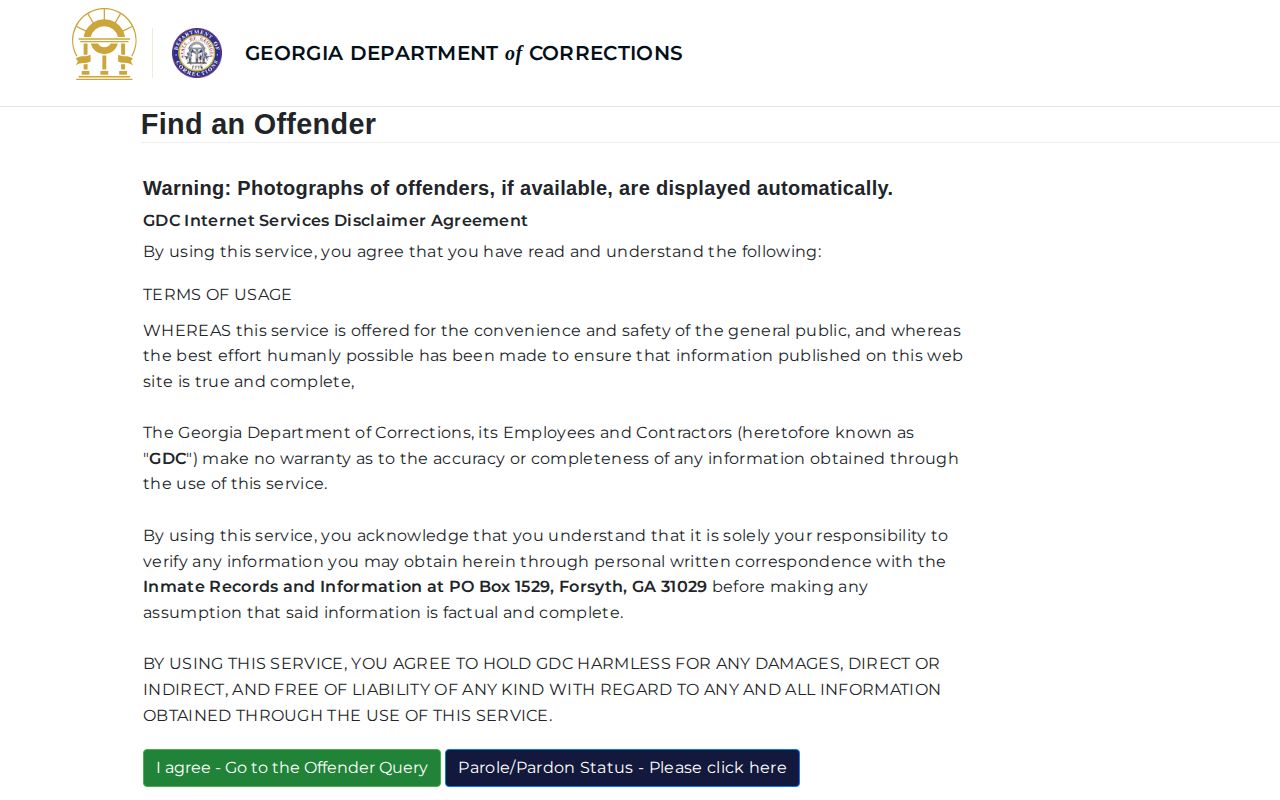
This statewide screen is the correct first route for a former Smith resident; the Evans County current-custody path answers a different question.
After a Smith Center Release
Where a person goes depends on the state action recorded at departure. Community placement can include parole or another supervised status. A transfer sends the person to another state placement and is not freedom from custody. Full discharge has a different meaning from parole because supervision may no longer remain on that sentence. The GDC record supplies the custody status, while the parole board and DCS provide the next layer when supervision follows.
| Record result | What it can mean | Next source |
|---|---|---|
| New GDC location | The person moved within state custody | GDC offender detail |
| Parole status | Confinement ended with supervision | Parole board and DCS |
| Released status | A state custody event ended | GDC release field and records |
| Discharged status | The relevant term may be complete | GDC, DCS, or court record |
| No clear update | Data may lag or the match may be wrong | GDC records inquiry |
Do not use disappearance from a roster as proof. Smith Transitional Center residents are not supposed to be tracked through the Tattnall current-inmate interface or the Evans County sheriff roster. Those sources concern local jail custody. A GDC result can remain visible after a state release, making it more useful for past custody than a live county list. For broader state and county distinctions, the Evans County release search maps each custody type to its proper agency.
Smith Transitional Center Release Records
The public offender result is a lookup record, not a certified discharge file. When more detail is needed, use the GDC agency open-records route. A narrow request is easier for the records officer to identify. Include the person's full legal name, date of birth if known, GDC ID, Smith Transitional Center as the relevant facility, and the approximate period involved. State the exact item sought, such as actual release date, discharge status, transfer history, or a sentence-computation record.
Georgia's Open Records Act, O.C.G.A. 50-18-70 through 50-18-77, provides the general process for public agency records. An agency generally responds within three business days by providing responsive records, citing a basis for withholding or redaction, or stating when production will be available. Lawful search, retrieval, redaction, and copy costs may apply. No fixed Smith Transitional Center fee is published in the supplied research, so a requester should ask GDC for a cost estimate instead of assuming a price.
Some information may be withheld or limited. Sealed matters, legally restricted records, confidential material, or records controlled by another agency can change the response. If GDC does not hold the court order being sought, use the sentencing county's clerk. Georgia's PeachCourt and re:SearchGA systems can provide an online starting point, but the clerk remains the official custodian and access varies by court and document.
Smith Transitional Center Contact Details
GDC lists the physical location as 8631 Hwy 301 North, Claxton, Georgia 30417. Mail goes to P.O. Box 869, Claxton, Georgia 30417. The public GDC location page routes inmate concerns and questions to 404-656-4661. The research does not provide local visiting hours or a direct records-desk number, so none should be assumed. Confirm current operating or access information through GDC before travel or mailing.
Official facility information
Smith Transitional Center
8631 Hwy 301 North
Claxton, GA 30417
Mail: P.O. Box 869, Claxton, GA 30417
GDC inmate concerns/questions: 404-656-4661
Agency: Georgia Department of Corrections
The official Smith Transitional Center location page is also the visual source for the facility information below.
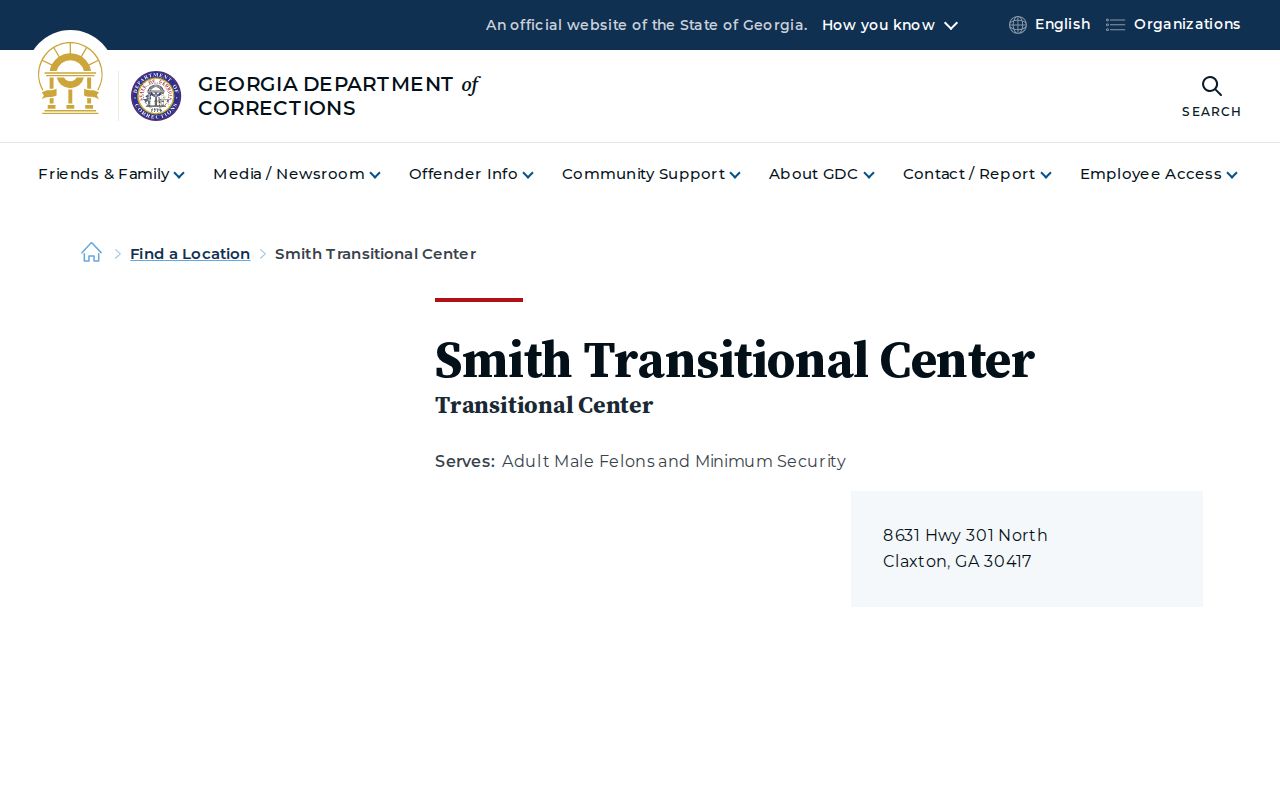
The location record confirms the center's GDC identity and Claxton address, which is why state channels control release verification.
Smith Transitional Center Reentry Role
Smith's local significance is different from that of a jail or secure state prison. GDC describes it as a transitional center. Its adult male residents are in a minimum-security setting connected to movement from secure custody toward community placement and supervision. That purpose makes the follow-up record especially important. A departure from the center can be one step in a longer sentence path rather than a clean end to all state authority.
DCS supervises felony probationers and parolees in the community. Its location finder is the safest route to the current field office because office boundaries and routing can change. The State Board of Pardons and Paroles handles parole decisions and maintains public information at its official site. A court docket adds sentence context, but it should not be used alone to claim that GDC physically released someone on a certain date.
- Parole
- Release from confinement before the sentence fully ends, with conditions and supervision.
- Probation
- A court-ordered community sentence or term that may follow custody.
- Transfer
- Movement to another agency or facility, not release to the community.
- Discharge
- Completion of the identified custody or supervision obligation, as the official record defines it.
Read each system for the job it performs. GDC confirms the state custody path. The parole board explains a parole action. DCS identifies community supervision. The court explains the sentence or later order. Together they answer whether the person left Smith, where legal authority moved next, and whether supervision remains.
Claxton State Release Confusion
Claxton contains several correctional footprints. Smith Transitional Center and Womens Detention Center are state facilities, while Evans County Sheriff's custody is local. A search for “Evans County released inmates” can therefore point to people held under very different authorities. Geography does not decide which agency owns a release record. The operator and custody type do.
For a former Smith resident, start with GDC even when an Evans County address appears in the facility listing. Use the sheriff only if the person also had a distinct Evans County jail booking. Use the court for the sentence and orders, not as a substitute for the physical GDC release entry. This separation prevents a county roster absence from being mistaken for proof of a state discharge and keeps the search tied to the agency that created the record.